
India on Tuesday conveyed to China the importance of maintaining peace and tranquility along the Line of Actual Control (LAC) for overall bilateral ties as national security advisor Ajit Doval held talks with Chinese Foreign Minister Wang Yi focusing on delimitation of the frontier and sustaining work on trans-boundary cooperation.
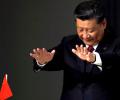
Chinese President Xi Jinping on Tuesday visited an exhibition of the Communist Party, appearing in public for the first time after his return from the SCO summit on September 16, which sparked rumours about his absence from the limelight ahead of next month's key Congress of the ruling party.

A question has been raised whether the Mecca Pact will have a negative impact on our doctrine that the Operation Sindoor has only been suspended and that it would be resumed if Pakistan engages in terrorism in the future. But the Mecca Pact only speaks of aggression, not defence against terrorism, points out Ambassador T P Sreenivasan.

Defence Minister Rajnath Singh met his Chinese counterpart Admiral Dong Jun in Bishkek to discuss maintaining peace and tranquility along the Line of Actual Control (LAC) and broader regional security concerns.

Chinese Foreign Minister Wang Yi stated that President Xi Jinping and Prime Minister Narendra Modi reached a crucial consensus during the BRICS summit, agreeing that China and India should be partners, not rivals. The leaders pledged to maintain peace and tranquility in border areas, deepen cooperation, and support each other in multilateral forums, aiming to strengthen the Global South and promote a multipolar world order.

India and China are in what experts call 'a cooperation-versus-competition situation'.

During the 18th BRICS Summit in New Delhi, Chinese President Xi Jinping and Prime Minister Narendra Modi held a bilateral meeting, outlining a four-point approach for the steady and long-term development of China-India relations. The leaders stressed strategic understanding, win-win cooperation, mutual respect, and inclusive multilateral engagement, reaffirming their commitment to resolving the boundary question and addressing economic concerns. They also discussed global challenges and strengthening people-to-people ties.

Former CDS Anil Chauhan stated that China poses a long-term and comprehensive challenge to India, with the boundary issue remaining unresolved due to differing perceptions of the Line of Actual Control. However, he emphasised that India's ties with Beijing cannot be solely defined by border disputes, advocating for engagement through platforms like SCO and BRICS. He also highlighted the broader global geopolitical flux and instability in India's neighbourhood as significant security concerns, stressing the need for self-reliance.

India and China held constructive talks on the situation along the Line of Actual Control (LAC) in eastern Ladakh, emphasising that maintaining border peace and tranquillity enabled progress in normalising overall relations.
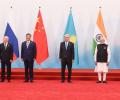
The Shanghai Cooperation Organisation (SCO) strongly condemned the Pahalgam terror attack and concurred with India's position that 'double standards' in the fight against terrorism are unacceptable.

'Prime minister is expected to hold some bilateral meetings on the sidelines of the SCO summit.'
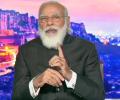
The remarks by Modi at a virtual SCO summit came in the backdrop of the Sino-India border row.
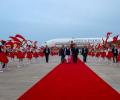
Prime Minister Narendra Modi arrived in China for the Shanghai Cooperation Organisation (SCO) summit. His meeting with President Xi Jinping is significant given global economic concerns.

Uttam Ghosh offers his take on the smile fest at the SCO summit in Tianjin.

Kremlin spokesman Dmitry Peskov said the two leaders had a tete-a-tete in the car for about an hour.

In his address, the PM also hit out at those making repeated attempts to "unnecessarily" bring bilateral issues to the SCO in violation of the grouping's foundational principles, in an oblique reference to Pakistan.

Prime Minister Narendra Modi is expected to visit Japan and China starting around August 29. The visit to China would be his first after the Ladakh border standoff.

Russian President Vladimir Putin stated that Moscow would not interfere in the "delicate" bilateral relations between India and China, expressing confidence in their ability to resolve border disputes amicably. He also discussed Russia's independent partnerships with both nations, touched upon India-Pakistan ties, and highlighted ongoing and proposed defence cooperation with India, including the BrahMos missile and a potential Su-57 fighter jet project.

President Putin and Prime Minister Modi greeted each other with a warm hug, after which they walked towards the stage for a family photo of the SCO members.
Prime Minister Narendra Modi greeted Russian President Vladimir Putin on his birthday and conveyed that he was looking forward to welcoming him in India for the upcoming India-Russia annual summit.

Prime Minister Narendra Modi and Chinese President Xi Jinping are set to meet in Tianjin on Sunday, their first in about 10 months, for wide-ranging talks aimed at improving relations.

Noting that terrorism is haunting the Asian and Central Asian regions, Prime Minister Manmohan Singh on Tuesday underlined the need for "genuine" cooperation among countries on a global scale to resolutely defeat the menace.
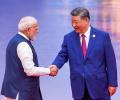
India's dual pursuit of a robust strategic partnership with Washington and a pragmatic, tension-management policy with Beijing represents the essence of modern multi-alignment. By embracing economic pragmatism, learning to compartmentalize political differences, and engaging in continuous dialogue, India can secure its borders, grow its economy, and contribute to a stable, multipolar Asian century, points out Ambassador Rajasekhar.
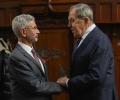
India's External Affairs Minister S Jaishankar addressed the Shanghai Cooperation Organisation (SCO) Council of Heads of Government meeting, advocating for a 'zero tolerance' approach to terrorism and emphasizing the need for the SCO to adapt to the changing global landscape.

The Global Times, a prominent state-run Chinese media outlet, published an article titled "China and India are cooperation partners, not rivals: Xi," highlighting President Xi Jinping's remarks about the bilateral meeting, saying, "as long as the two countries stick to this overarching direction, China-India relations can sustain steady and long-term growth."

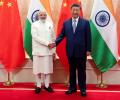
Chinese Foreign Minister Wang Yi has called on India and China to view each other as partners rather than rivals, emphasising the importance of cooperation for regional stability and development.

A meeting with Chinese President Xi Jinping on the sidelines of the SCO summit is being planned.
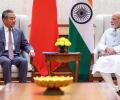
China's Foreign Minister Wang Yi expressed China's anticipation for Prime Minister Narendra Modi's visit to the Shanghai Cooperation Organisation (SCO) summit, emphasizing the importance of strong India-China relations and mutual cooperation.

Uzbek President Shavkat Mirziyoyev chaired the 22nd SCO summit in Samarkand which was attended by Prime Minister Narendra Modi.
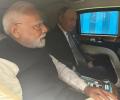
Prime Minister Narendra Modi was offered a lift by Russian President Vladimir Putin in his AURUS limousine to reach the venue of their bilateral talks on the sidelines of the Shanghai Cooperation Organisation (SCO) summit in Tianjin on Monday.

Twenty-six foreign leaders, including Vladimir Putin and Kim Jong Un, will attend China's V-Day commemorations on September 3. Japan has expressed concerns about the event's anti-Japanese overtones.

Pakistan's Army Chief Field Marshal Asim Munir met with Chinese President Xi Jinping, along with Pakistani Prime Minister Shehbaz Sharif, to discuss bilateral and regional cooperation. The meeting occurred during Sharif's visit to China for the Shanghai Cooperation Organisation (SCO) summit.

During a weekly press briefing, the Foreign Office Spokesperson Mumtaz Zahra Baloch said that invitations have been sent to the heads of countries to participate in the meeting which will take place on October 15-16, the Dawn newspaper reported.

Check out these images from the Shanghai Cooperation Organisation summit in Tianjin, China, on Monday morning featuring Prime Minister Narendra Modi, Chinese President Xi Jinping and Russian President Vladimir Putin, taking bon homie to a new level.

India is navigating a complex diplomatic landscape, attempting to balance its 'forever honeymoon' with the Israel-UAE-Bahrain axis against its historical ties with Iran, as evidenced by recent high-level visits and evolving geopolitical realignments in the Middle East, observes Ambassador M K Bhadrakumar.
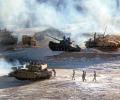
While tensions have eased at several friction points and mechanisms for managing the boundary have been reactivated, underlying differences persist. Disputes over naming practices in Arunachal Pradesh, continued infrastructure development on both sides, and unresolved questions regarding patrolling rights indicate that the structural gap remains, notes Dr Kumar.
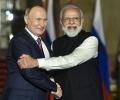
Russian President Vladimir Putin and Prime Minister Narendra Modi will meet on the sidelines of the SCO summit in Uzbekistan this week and discuss issues of strategic stability, the situation in the Asia Pacific region and bilateral cooperation within the UN and G20, the Kremlin has announced.
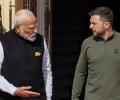
Prime Minister Narendra Modi conveyed to Ukranian President Volodymyr Zelenskyy that India supports all efforts to end the conflict in Ukraine during a phone conversation.
For India, China's Indian Ocean power projection, maritime domain awareness, dual-use ports, underwater surveillance, antisubmarinewarfare, naval exercises with Pakistan, pose considerable pressure, depleted India's strategic depth and marginalises Indian role, points out Srikanth Kondapalli.
